Model Training, Prompt Engineering, RAG: What Gives?
 By Solaeris · 11 min read
A practical guide to conversational AI, prompt engineering, retrieval-augmented generation, and fine-tuning for business applications.
One of the most common questions we hear from organizations exploring artificial intelligence is deceptively simple:
How should we actually use AI in our business?
Should we train our own model? Use ChatGPT or Claude? Build a custom AI application? Implement retrieval-augmented generation (RAG)?
The terminology can be confusing, and the implications for cost, complexity, and business value are substantial.
The good news is that most organizations don’t need to develop a new AI model from scratch. Today’s leading foundation models already possess extraordinary capabilities in language, mathematics, software development, research, and reasoning.
Organizations can apply those capabilities to their proprietary data, existing software systems, and business processes.
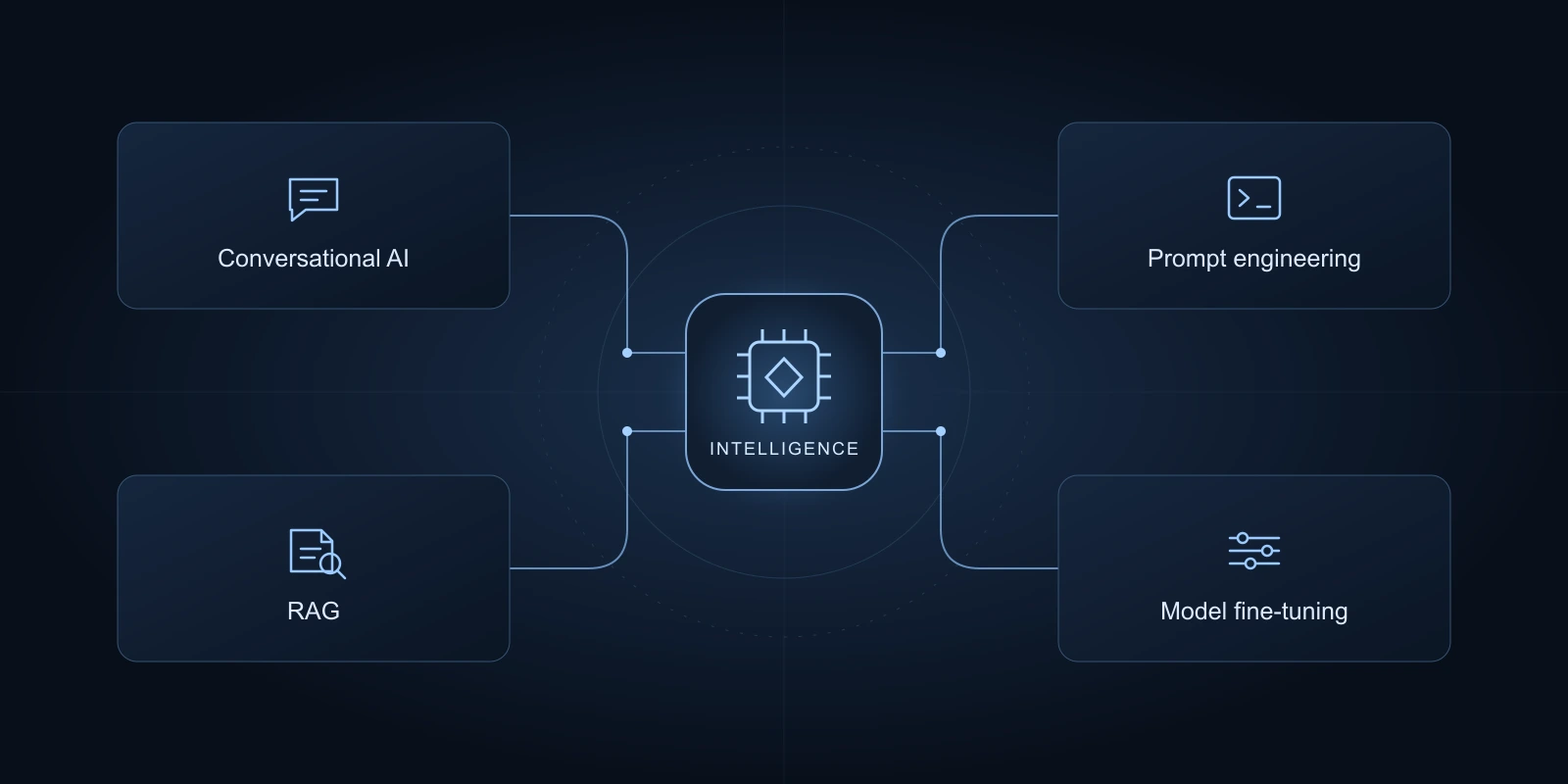
At Solaeris AI, we generally think about four practical approaches: conversational AI, prompt-engineered applications, retrieval-augmented generation, and model fine-tuning.
They solve different problems, and understanding where each belongs can save an organization considerable time and investment.
First, Why Not Just Train Our Own AI Model?
Training a frontier-class foundation model is an entirely different undertaking from developing an enterprise AI application.
According to Stanford University’s 2025 AI Index, the estimated compute cost of training GPT-4 was approximately $79 million, while Meta’s Llama 3.1 405B was estimated at approximately $170 million. These estimates do not represent the full organizational cost of research, personnel, data acquisition, experimentation, or infrastructure.
For most businesses, such an investment would be unnecessary.
An existing model can already understand complex contracts, interpret financial information, analyze technical documents, assist with medical research, and write sophisticated software.
Businesses can build on these existing capabilities by supplying the information, instructions, and safeguards a model needs to perform useful work within the organization.
1. Conversational AI: The Easiest Place to Start
ChatGPT, Claude, Gemini, and similar conversational interfaces have made sophisticated artificial intelligence accessible to virtually anyone.
OpenAI reported more than 900 million weekly active ChatGPT users in 2026—a remarkable demonstration of AI’s mainstream adoption.
Employees can use these tools to research unfamiliar topics, draft correspondence, summarize information, explore ideas, and solve everyday problems.
And there is compelling evidence that conversational AI can improve productivity.
A study by researchers from Stanford and MIT examining more than 5,000 customer support agents found that access to an AI assistant increased productivity by approximately 14% on average, with gains of approximately 34% among less experienced and lower-skilled workers.
The findings suggest that AI can help distribute expertise throughout an organization, allowing less experienced employees to benefit from techniques ordinarily associated with their more accomplished colleagues.
These gains vary by task, and some uses of AI can reduce performance.
In a Boston Consulting Group study involving consultants using GPT-4, participants working on tasks outside the model’s demonstrated capabilities performed 23% worse than those completing the same tasks without AI.
This illustrates what researchers describe as AI’s jagged technological frontier: a model may perform exceptionally well at one sophisticated task while struggling with another that seems comparatively straightforward.
Conversational AI can help employees with everyday research and writing. Integrating it into a business process requires further decisions about data access, workflow, review responsibilities, and how to measure the results.
2. Prompt Engineering: Turning AI Into a Business Application
Prompt engineering involves designing and structuring the instructions, context, constraints, and expected outputs provided to an AI model.
Instead of asking employees to manually type questions into a chatbot, a business can build software that automatically assembles relevant information and submits structured requests through an AI model’s API.
This approach becomes particularly powerful when combined with workflow automation, existing databases, and enterprise software.
Consider an example from our healthcare-related development work.
A physician evaluating a patient may need to consider years of medical history: laboratory results, vital signs, medications, treatment responses, physician notes, and previous diagnoses.
Manually collecting and interpreting this information can be time-consuming.
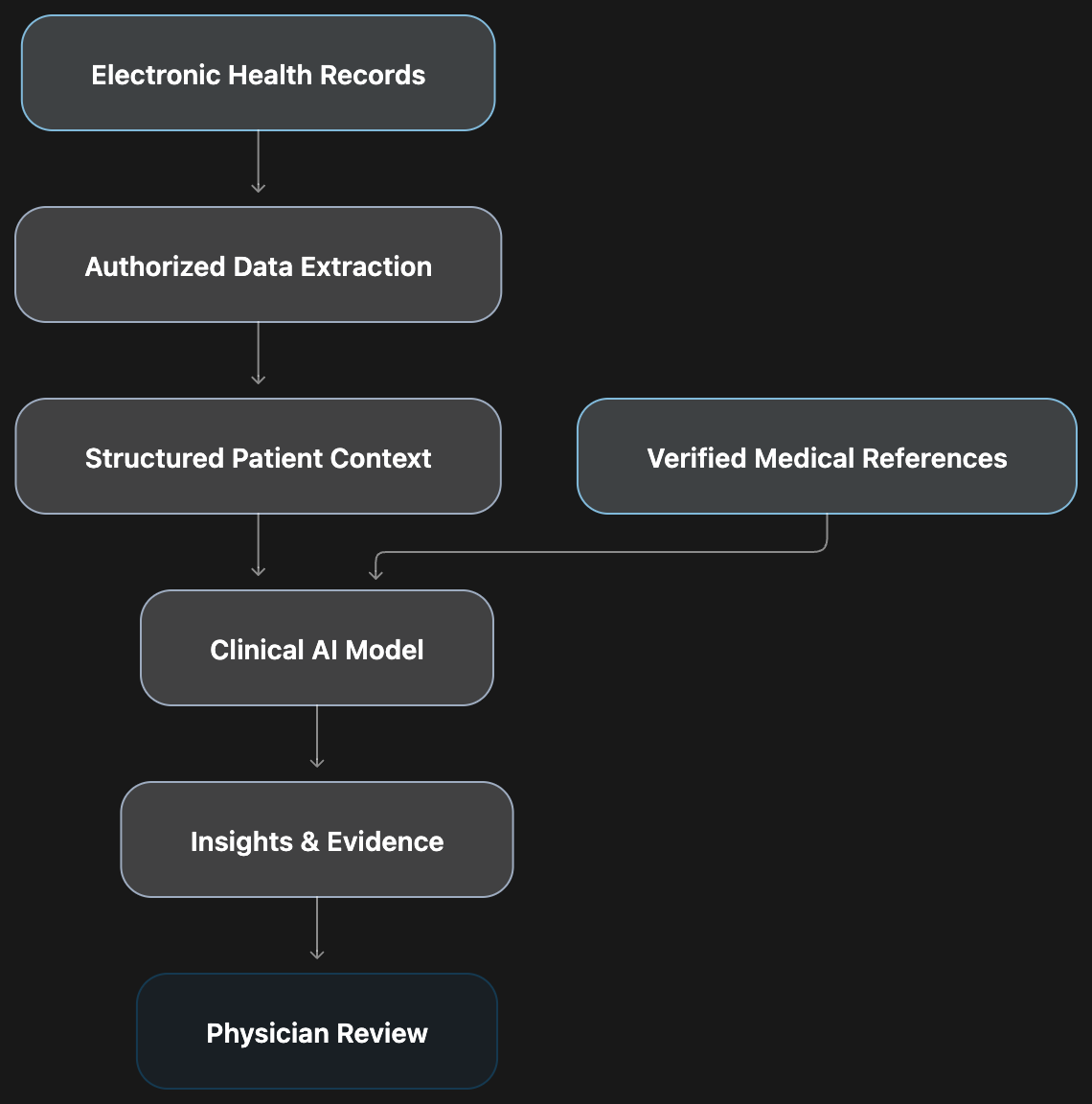
A custom electronic health record (EHR) application can automate much of the preparation:
- Retrieve relevant patient history from authorized data sources.
- Normalize and organize hundreds, potentially more than a thousand, clinical data points.
- Identify relevant patterns, trends, changes, and missing information.
- Assemble a structured, patient-specific prompt.
- Submit that information to an appropriate AI model.
- Present a clinician-facing summary of potential considerations, supporting evidence, and questions for further investigation.
The physician remains responsible for reviewing the information and exercising clinical judgment.
Importantly, the AI model does not need to be retrained on the patient’s records. The application supplies relevant information at inference time, allowing the model to apply its existing capabilities to that particular case.
Where medical literature is required, a properly designed implementation can retrieve and verify external evidence rather than relying on the model to recall or invent citations.
Clinical AI also requires appropriate validation, privacy controls, and consideration of FDA clinical decision-support guidance. A polished AI response is not, by itself, a clinically validated recommendation.
A clinical workflow with physician oversight
Why Prompt Engineering Matters
This approach can transform an AI model from an isolated chat interface into a functioning component of enterprise software.
And because the organization is using an existing model, implementation can often be substantially less expensive and faster than model training.
Much of the engineering effort goes into acquiring the correct data, validating inputs, coordinating the workflow, handling exceptions, and checking the response. These parts of the application determine what information reaches the model and whether employees can use its output reliably.
3. Retrieval-Augmented Generation (RAG): Making Proprietary Knowledge Searchable
What if your organization has tens of thousands—or millions—of documents containing valuable institutional knowledge?
That might include contracts, legal filings, engineering specifications, financial reports, client correspondence, technical manuals, or internal research.
Questions about concepts or relationships can be difficult to answer when relevant information is expressed differently across thousands of documents. Retrieval-augmented generation, commonly called RAG, combines an existing AI model with a searchable repository of external or proprietary information to help address those questions.
Rather than attempting to teach the model everything contained in your document library, the system retrieves relevant information when a question is asked and includes it in the model’s working context.
Example: A Law Firm Searching 10,000 Documents
Imagine a law firm with 10,000 case files, contracts, legal memoranda, and historical records.
An attorney wants to identify matters involving a particular contractual dispute, understand which arguments proved successful, and locate comparable outcomes.
Traditional keyword searches might require dozens of queries, followed by hours of reviewing irrelevant or partially relevant documents.
A well-designed RAG system can approach this problem differently.
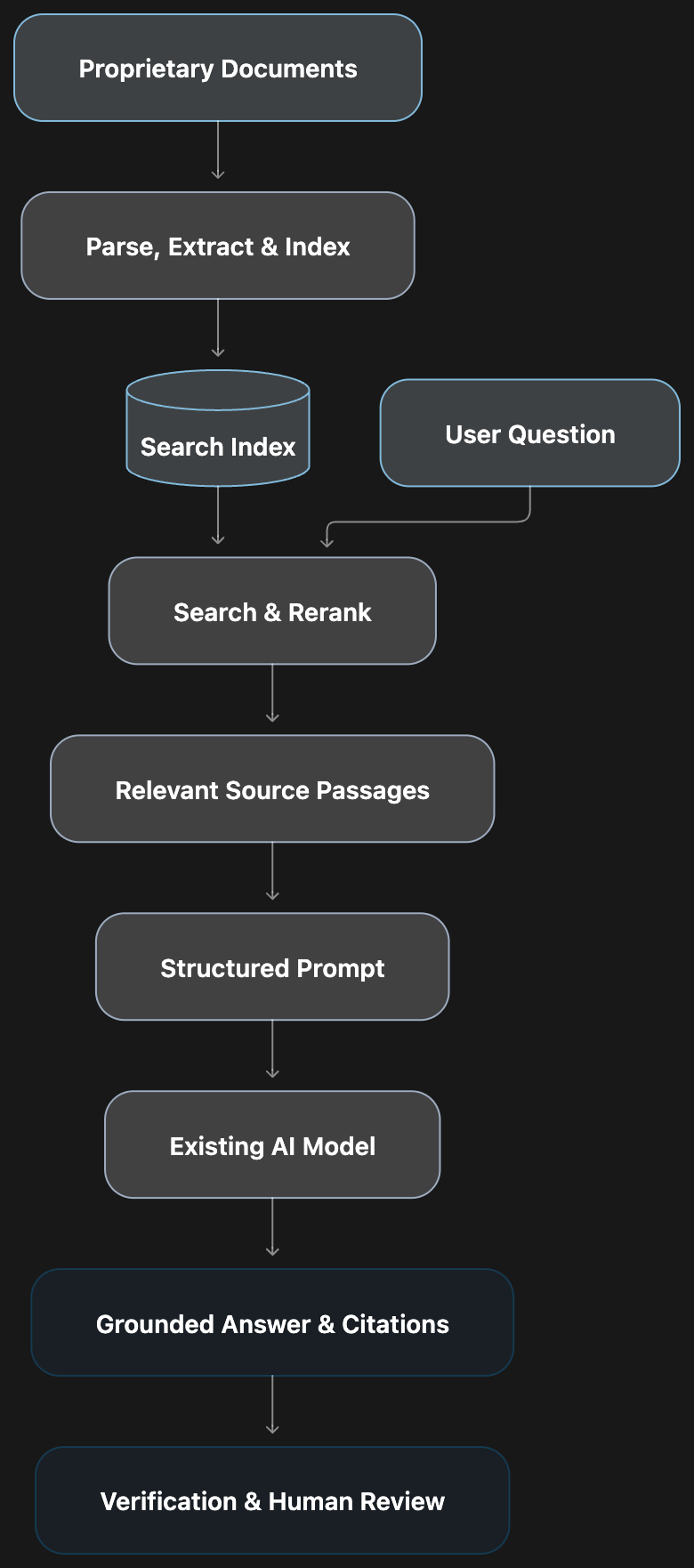
First, documents are ingested, parsed, and organized. Relevant sections are indexed using techniques such as semantic embeddings, keyword search, document metadata, and structured information extraction.
When an attorney submits a question, the system can use semantic search to find related information even when the wording differs from the query.
It might identify relevant paragraphs across multiple cases, retrieve related documents, and present them to an AI model for analysis.
The resulting response can synthesize similarities, highlight distinctions, and reference specific source documents, pages, or passages for verification.
Alongside the retrieved documents, the system can provide an explanation of how they relate to the attorney’s question.
This does not eliminate legal research or professional review. Relevant cases can be missed, citations must be verified, and legal authorities must be checked for currency and validity.
But it can meaningfully reduce the effort required to locate and organize potentially useful information.
From private documents to grounded answers
What Makes RAG Technically Challenging?
A RAG system needs to select relevant passages that fit within the model’s context window. Submitting an entire enterprise document library for every query is generally impractical, and repeatedly processing large amounts of text can be costly.
Effective RAG architecture often requires:
Document preparation: Parsing files, extracting structured metadata, preserving relationships between sections, and correcting scanning or formatting issues.
Intelligent retrieval: Combining semantic search with keyword search, metadata filtering, and reranking to identify the most relevant passages.
Context optimization: Selecting useful information while minimizing unnecessary tokens, latency, and inference cost.
Grounding and verification: Connecting generated statements to retrieved evidence, validating quotations and citations, and allowing the model to acknowledge insufficient information.
Security: Ensuring that information retrieved by the system respects organizational permissions, confidentiality requirements, and data-access restrictions.
A system can produce a highly convincing answer even when the retrieval process has failed. That is why testing retrieval quality and answer correctness separately is critical.
Turning Data Into a Competitive Advantage
RAG offers an interesting strategic opportunity.
Two competing companies might use precisely the same foundation model, but one has decades of proprietary research, client history, engineering documentation, and institutional knowledge.
With the right retrieval architecture, that company can make its private information dramatically more useful.
By retrieving relevant material from that collection, the company can use an existing model to answer questions informed by its own research and experience. The repository can also be updated as information changes, without retraining the underlying model.
4. Fine-Tuning: When You Actually Need to Modify the Model
Unlike prompt engineering or conventional RAG, fine-tuning modifies a model’s learned parameters.
It starts with an existing pretrained model and continues training it on carefully prepared examples designed to improve its performance on particular tasks.
For instance, an organization might want a model that consistently classifies specialized insurance claims, extracts technical attributes from complex engineering documents, follows a particular reporting format, or interprets domain-specific terminology.
Fine-tuning can be useful when prompt engineering alone does not achieve the required consistency, accuracy, or efficiency.
LoRA: Making Model Customization More Accessible
One popular approach is Low-Rank Adaptation, or LoRA.
Instead of updating all the parameters of a model, LoRA freezes the original weights and trains a much smaller set of additional parameters.
A related technique, QLoRA, combines parameter-efficient adaptation with quantization to reduce memory requirements.
In their landmark QLoRA paper, researchers demonstrated fine-tuning a 65-billion-parameter model using a single 48 GB GPU.
This result illustrates how parameter-efficient methods can make smaller fine-tuning experiments affordable. The total cost of a business implementation also includes proprietary data preparation, expert labeling, multiple experiments, validation, security, integration, hosting, and ongoing maintenance. Those costs can substantially exceed the cost of the GPU training job.
When Is Fine-Tuning Worthwhile?
Potential applications include insurance claims classification, specialized document extraction, industry-specific language processing, and certain scientific or technical workloads.
However, simply giving a model large quantities of proprietary documents does not guarantee better results.
Fine-tuning generally requires training examples that teach the desired behavior, plus independent evaluation data to determine whether performance actually improves.
For factual information that changes frequently, RAG is often a better choice.
For repeatable behavior, specialized output structures, or tasks where a smaller model must perform with high consistency, fine-tuning may be more appropriate.
Some applications combine the two: a fine-tuned model performs a specialized task while RAG retrieves relevant, current, or proprietary information.
So Which Approach Should Your Business Use?
The business requirement provides a useful starting point for choosing an approach.
| Business requirement | Suggested starting point |
|---|---|
| General research, writing, and everyday employee productivity | Conversational AI |
| Automating a repeatable workflow using existing software and data | Prompt-engineered application |
| Searching proprietary documents and generating evidence-backed answers | RAG |
| Improving consistent task-specific behavior or specialized outputs | Fine-tuning |
| Combining specialized behavior with large or changing knowledge sources | Fine-tuning + RAG |
Choose an approach around your business objective
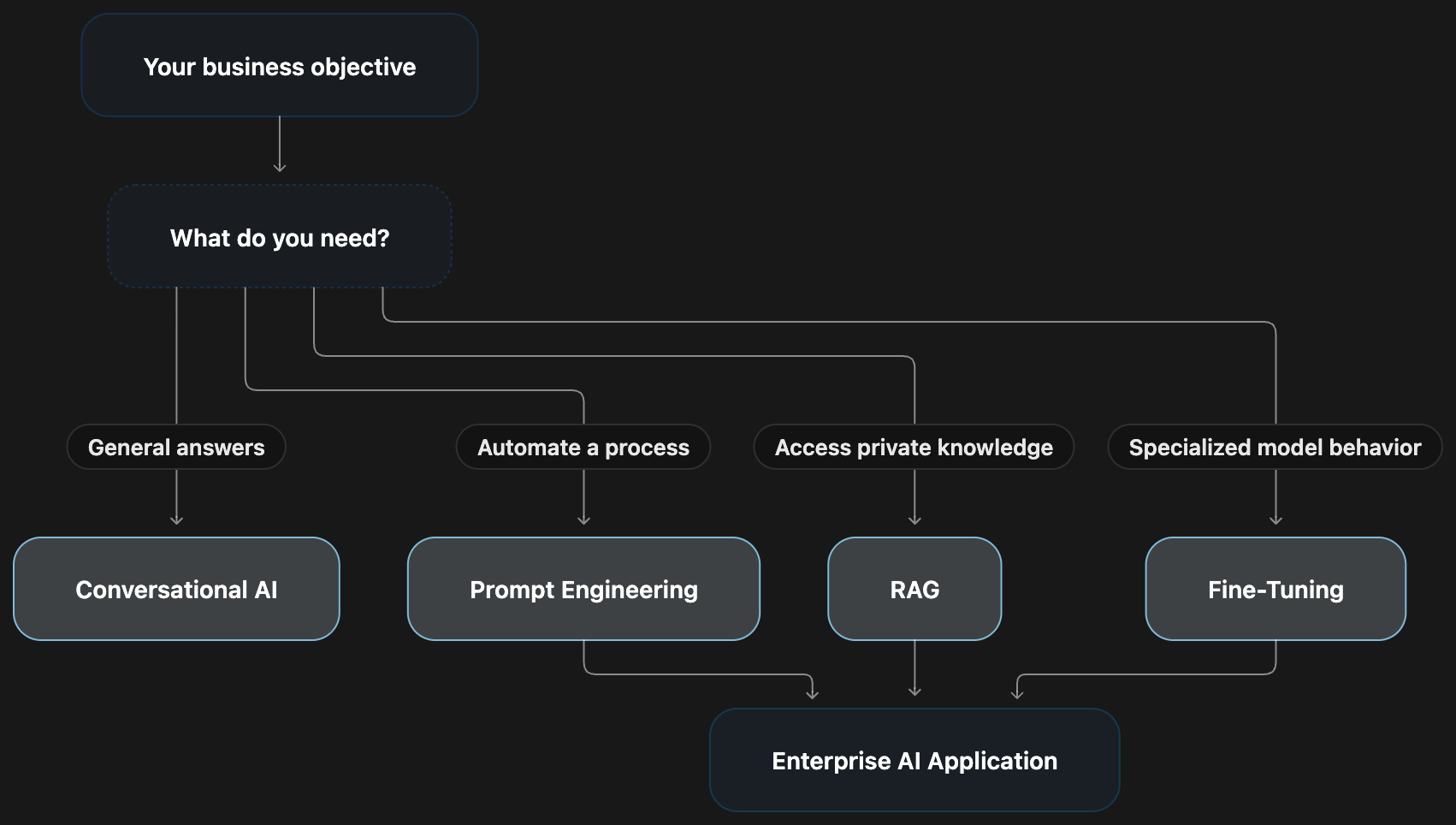
These approaches are not mutually exclusive.
An enterprise AI system might retrieve information using RAG, assemble a structured prompt, invoke a fine-tuned model, validate the results, and deliver the output within an existing business application.
Some systems can also use AI agents to coordinate multiple steps, call software tools, and perform approved actions using existing models.
Evaluating the Business Results
Evaluating an AI implementation requires looking at how consistently it performs the intended work. Data quality, information access, workflow integration, accuracy, security, and human oversight all affect the results.
Organizations should define what success looks like before choosing a technical architecture.
Can the system reduce contract review time? Improve claims-processing throughput? Shorten research cycles? Reduce manual administrative work? Identify valuable insights hidden in decades of proprietary records?
At Solaeris AI, we use those objectives to define the work and evaluate possible implementations. Depending on the requirements, the project may involve an integration with an existing model, a retrieval pipeline, or a fine-tuned model. We assess each option against the accuracy, cost, and reliability the business needs before committing to an architecture.
Ready to Explore Where AI Fits Your Business?
At Solaeris AI, we help organizations design, develop, and deploy custom AI solutions built around their business processes, proprietary information, and operating requirements.
From prompt-engineered applications and enterprise RAG systems to private AI deployments and specialized model customization, we focus on practical implementations with measurable business value.
Request a free AI opportunity analysis
References and Further Reading
- Stanford HAI, 2025 AI Index Report — Research and Development. Estimates of frontier model training costs.
- OpenAI, Scaling AI for Everyone (2026). ChatGPT adoption figures.
- Brynjolfsson, Li, and Raymond, Generative AI at Work, NBER; subsequently published in The Quarterly Journal of Economics (2025).
- Boston Consulting Group, How People Create and Destroy Value with Generative AI (2023).
- Hu et al., LoRA: Low-Rank Adaptation of Large Language Models (2021).
- Dettmers et al., QLoRA: Efficient Finetuning of Quantized LLMs, NeurIPS (2023).
- Lewis et al., Retrieval-Augmented Generation for Knowledge-Intensive NLP Tasks, NeurIPS (2020).
- Amazon Web Services, Comparing Retrieval-Augmented Generation and Fine-Tuning.
- U.S. Food and Drug Administration, Clinical Decision Support Software — Final Guidance (January 2026).
- NIST, AI Risk Management Framework: Generative AI Profile (2024).