Instant project recall
Find technology stacks, operating systems, requirements, implementation approaches, and scope from past work.
Example prompt
“Which projects used Bluetooth Low Energy?”

Case study / Private AI & Sales Intelligence
How a mid-sized software development company turned its institutional knowledge into a searchable intelligence platform that accelerates proposals and helps its business development teams win more business.
Up to, user-reported
Self-reported improvement
Early sample, 10 opportunities
Early feedback and preliminary results. The small opportunity sample does not establish causation.
01 / The challenge
A mid-sized software development company had successfully delivered hundreds of applications across numerous industries, technologies, and platforms. Yet accessing that collective experience had become a significant operational challenge.
Critical project knowledge was fragmented across statements of work (SOWs), technical documentation, project records, and the memories of developers, technical leads, and project managers.
For business development teams, preparing a proposal or responding to a Request for Proposal (RFP) took over a week. The resulting materials often lacked the precision and context needed to secure every client.
Despite vast expertise, the company had no reliable way to articulate it to inquiring customers.
Some employees had left the organization. Others could not recall specific implementation details. Technical leads and project managers lacked time to participate in every proposal. Questions about Bluetooth Low Energy, a particular technology stack, or similar client work could take days to resolve.
02 / Our approach
Solaeris interviewed bid producers, account managers, technical leads, and other team members to understand how project knowledge was stored, shared, and retrieved.
Those conversations shaped a centralized platform that helps authorized employees discover and connect existing information, regardless of their technical background.
03 / The solution
Solaeris designed and developed a private AI knowledge platform that transforms thousands of internal documents into an intelligent, searchable repository.
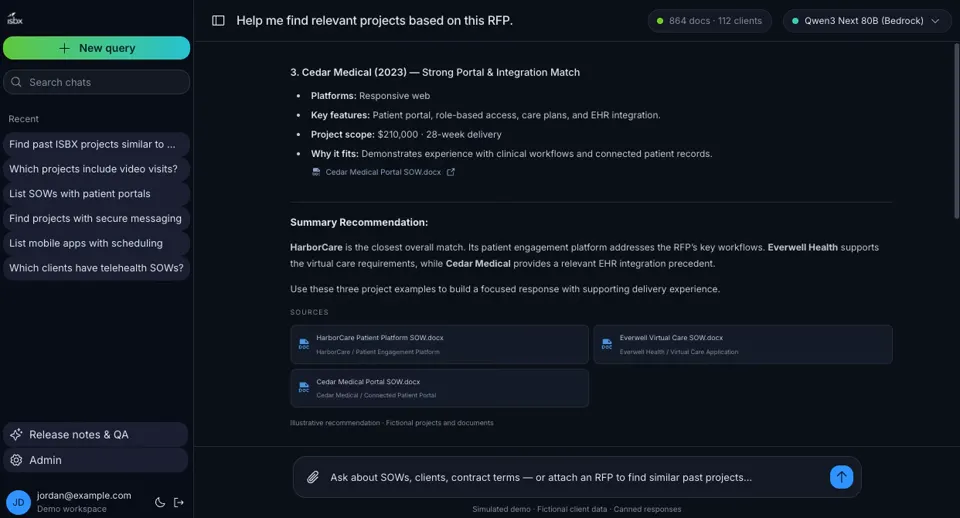
Employees can ask questions in natural language and receive contextually relevant answers grounded in the company’s actual project records.
Find technology stacks, operating systems, requirements, implementation approaches, and scope from past work.
“Which projects used Bluetooth Low Energy?”
Connect experience across industries, technologies, and project records, even when the same concept is described differently.
“Find projects in this industry approved by this department head.”
Upload an RFP and identify the three most relevant past projects, with supporting documentation to start the proposal.
“Which three projects are the closest match to this RFP?”
Follow citations and direct links to SOWs and scoping records to independently verify the answer.
“Show me the project records behind this answer.”
See it in action / Source-grounded answers
Follow a citation into the original project record and verify the detail behind the recommendation.
Verify the source: the answer’s citation opens the HarborCare statement of work and highlights the supporting passage about secure patient messaging.
04 / How it works
Confidential customer information and proprietary technologies stay within the private processing workflow. Public AI services such as ChatGPT, Claude, and Gemini were excluded.
An on-premises AI model extracted and structured information from thousands of documents. The extracted data was normalized, enriched with searchable metadata, and converted into vector representations for semantic retrieval.
Semantic retrieval finds conceptual relationships. Deterministic keyword and metadata matching locate precise technical details, such as named technologies or a department head. Hybrid search combines these approaches to retrieve relevant evidence.
The platform passes retrieved evidence to a privately hosted AI model. Responses include citations and direct links to underlying SOWs and scoping records, so users can examine the source material and verify the information.
05 / Early results
Users reported less time spent researching previous work and assembling proposal materials, alongside more accurate, contextually relevant responses and proposal content.
Illustration of the maximum reported time saving
Normalized illustration of “up to 85%” savings; not measured hours or an average across users.
The reported 2× perceived accuracy reflects users’ own assessments. The 2× proposal win rate is a 100% relative improvement in an initial sample of 10 processed opportunities.
These preliminary results do not establish causation or predict future performance.
Junior business development staff can research technical capabilities that previously required senior engineers.
Account managers can address client questions in real time without waiting to consult the development team.
Employees can draw on the firm’s documented project history, beyond what any one person can remember.
The bigger opportunity
Thoughtful data engineering, private AI infrastructure, and evidence-grounded retrieval made decades of accumulated experience accessible and verifiable. The company’s historical records became an enduring resource for business development.
Explore what AI could do for your business.
Let’s talk