

Case study 01 / Healthcare AI
Clinical intelligence
within the physician’s workflow.
Bringing evidence-grounded AI clinical insights to a Los Angeles medical practice.
Clinical AI Insights
Generated Oct 29, 2026 · 9:42 AM
Oct 29, 2026 · 9:42 AM — Kidney function trend
Oct 22, 2026 · 4:30 PM — Previous patient assessment
Illustrative assessments for the demo patient.Kidney function trend
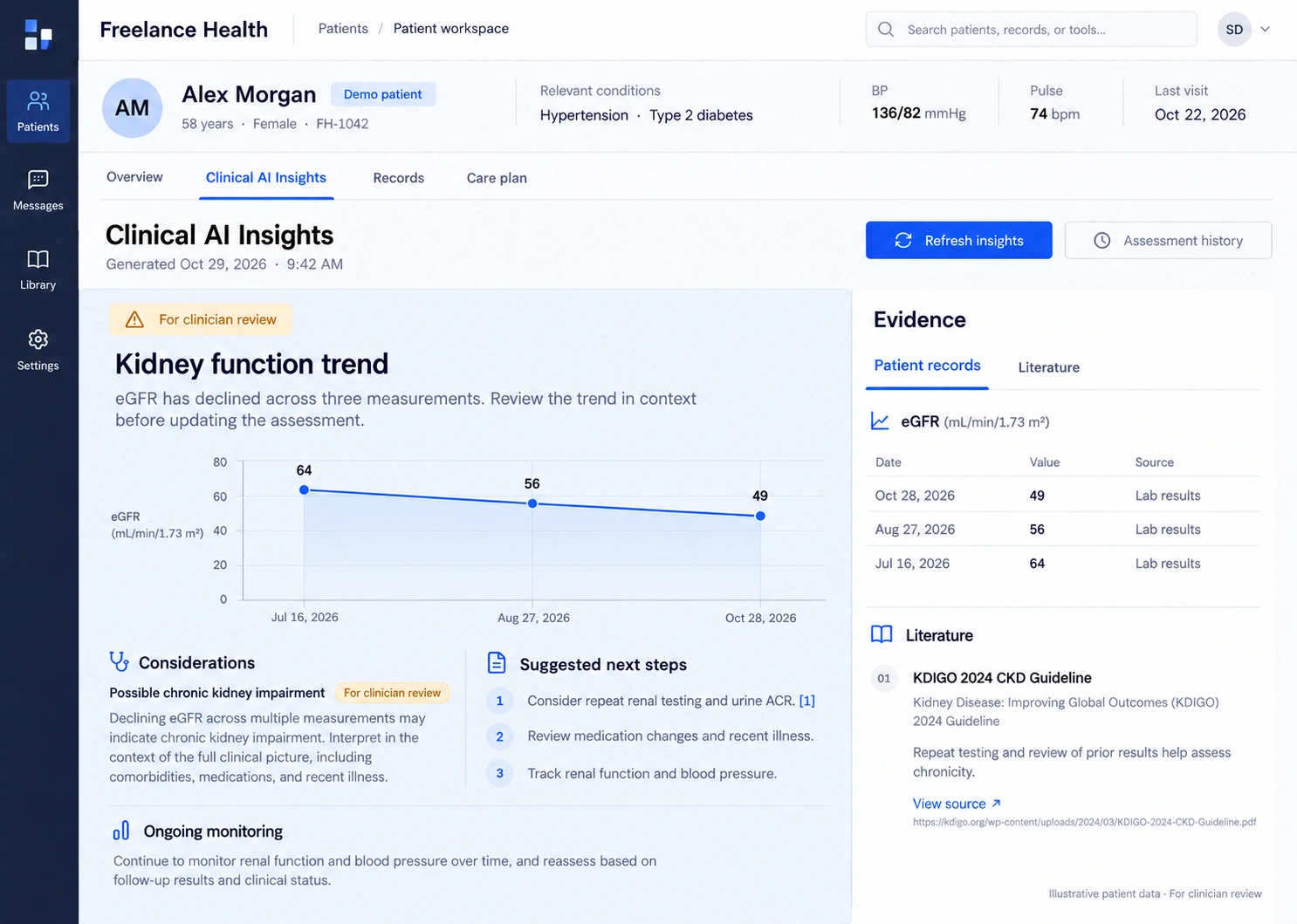
eGFR has declined across three measurements. Review the trend in context before updating the assessment.
Considerations
Possible chronic kidney impairmentDeclining eGFR across multiple measurements may indicate chronic kidney impairment. Interpret in the context of the full clinical picture, including comorbidities, medications, and recent illness.
Suggested next steps
- Consider repeat renal testing and urine ACR. [1]
- Review medication changes and recent illness.
- Track renal function and blood pressure.
Ongoing monitoring
Continue to monitor renal function and blood pressure over time, and reassess based on follow-up results and clinical status.
Animated interface demonstration · Illustrative patient data · All recommendations remain subject to clinician review
The opportunity
Understand the patient’s
clinical history.
Patient histories hold valuable signals across laboratory results, medications, and physician notes. Solaeris built an intelligent second opinion into the practice’s EHR, helping physicians uncover overlooked findings and investigate potential diagnoses.
The result brings clinical context, suggested next steps, and supporting medical evidence into one patient workspace.
The challenge in detail
The Challenge: Turning Patient Records Into Actionable Intelligence
Electronic Health Records (EHRs) contain enormous amounts of valuable patient information, but extracting meaningful insights from that data can be time-consuming, even for experienced physicians.
A patient’s medical history may span years of laboratory results, medications, diagnoses, physician notes, and clinical observations. Identifying subtle trends, potential diagnoses, or overlooked relationships requires physicians to synthesize information scattered across numerous records.
A Los Angeles medical practice partnered with Solaeris AI to address this challenge by integrating an evidence-grounded AI clinical decision-support system directly into its custom EHR platform.
The goal was to support physicians’ clinical judgment with an intelligent second opinion that continuously analyzes patient information and surfaces relevant findings supported by published medical literature.
Lower AI processing costs
Approximately, in comparative testing
Clinical data points
Organized across the patient’s history
Connected clinical workspace
Built into the physician’s EHR
01 / A connected workflow
The patient comes
into focus.
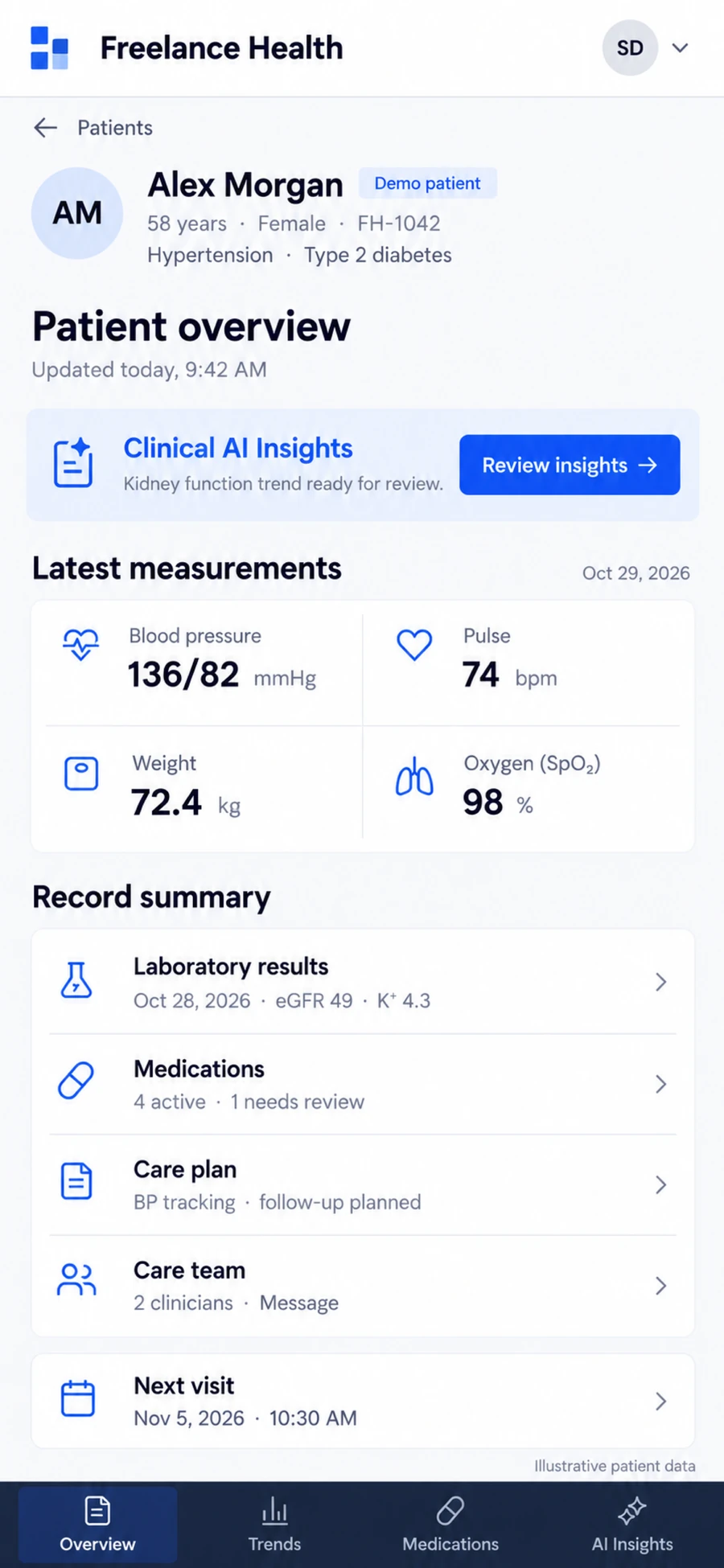
AI Insights lives where physicians already work. The patient overview brings current measurements, clinical records, and an assessment ready for review into a single mobile experience.
01 Patient context, immediately available
02 A direct path to the latest assessment
03 Findings retained for future review
How AI Insights fits into the EHR
The Solution: AI Insights Embedded Into the EHR
Solaeris developed AI Insights, a prominent feature within the EHR’s patient dashboard that provides physicians with an up-to-date, AI-generated clinical assessment.
For each patient, the system can generate:
- Suggested diagnoses
Potential conditions and differential diagnoses worth investigating, supported by relevant clinical evidence.
- Recommended testing
Additional laboratory tests, diagnostics, or evaluations that may help confirm or rule out suspected conditions.
- Actionable next steps
Proposed follow-up actions and clinical considerations for the treating physician.
- Ongoing monitoring
Key symptoms, laboratory trends, and clinical indicators to watch during subsequent patient visits.
- Medical citations
References to published clinical guidelines, peer-reviewed journals, and medical literature supporting the AI’s recommendations.
The system integrates with a specialized medical AI model through an API, using carefully engineered prompts and structured patient information to generate clinically relevant recommendations.
Each insight is timestamped, logged, and retained, allowing physicians to review prior assessments and understand how recommendations evolve as new patient information becomes available.
Patient overview / Mobile workspace
02 / Intelligence across time
See the history
behind the finding.
A single result tells part of the story. The longitudinal framework organizes clinical information over time, connecting changing measurements with medications and other observations.
Monitoring
Home readings and laboratory trends
Blood pressure
Latest · Today, 8:10 AM | 7 readings
Recent readings
| Date / time | Blood pressure | Pulse | Source |
|---|---|---|---|
| Oct 29, 2026 · 8:10 AM | 136/82 mmHg | 74 bpm | Home device |
| Oct 28, 2026 · 8:15 AM | 139/85 mmHg | 76 bpm | Home device |
| Oct 27, 2026 · 8:05 AM | 137/83 mmHg | 72 bpm | Home device |
| Oct 26, 2026 · 8:20 AM | 132/77 mmHg | 74 bpm | Home device |
| Oct 25, 2026 · 8:00 AM | 141/85 mmHg | 73 bpm | Home device |
| Oct 24, 2026 · 8:15 AM | 136/80 mmHg | 75 bpm | Home device |
| Oct 23, 2026 · 8:10 AM | 143/86 mmHg | 76 bpm | Home device |
Standardized records and relevant lookback periods help physicians identify meaningful changes over time.
Inside the longitudinal framework
Building a Longitudinal Patient Intelligence Framework
One of the most important technical challenges was determining how to present patient information to the AI model.
Working closely with the practice’s physicians, our team studied how clinicians evaluate patient cases, interpret historical findings, and formulate diagnoses.
We explored multiple approaches, including submitting raw EHR data directly to the AI model versus preprocessing and structuring that information ourselves.
We discovered that the way information was organized had a substantial impact on both the quality of the AI’s output and the cost of processing it.
Solaeris developed a Longitudinal Patient Intelligence Framework that organizes and interprets patient information across time.
The framework processes more than 100 clinical data points across categories including patient demographics, medical history, medications, allergies, laboratory results, vital signs, physician notes, diagnostic findings, surgical history, and family history.
We leveraged the FHIR (Fast Healthcare Interoperability Resources) healthcare data standard to support consistent clinical data representation and interoperability.
Our processing pipeline normalizes records into standardized formats, assigns appropriate historical lookback periods based on data type, and models meaningful changes over time.
For example, the system can provide historical measurements, identify trends, and contextualize those changes against medication history and other clinical observations.
This structured information is then submitted to the medical AI model for interpretation.
The architectural advantage
Reduce processing costs
with structured patient data.
Preparing and structuring patient information before calling the model reduced AI usage costs by approximately 90% in comparative testing, while improving the accuracy and clinical relevance of the generated insights.
How the cost reduction was achieved
A 90% Reduction in AI Processing Costs
Our comparative testing demonstrated that intelligently structuring patient information could reduce AI model usage costs by approximately 90%, while improving the accuracy and clinical relevance of generated insights.
By performing much of the data preparation and temporal analysis before invoking the AI model, we substantially reduced unnecessary token consumption and repetitive processing.
This approach also improved consistency by ensuring that the model received standardized, contextually relevant clinical information rather than having to independently reconstruct a patient’s medical history from raw records.
The result was a more efficient architecture designed to scale as the number of patients, records, and clinical interactions grows.
Medication reconciliation / Mobile workspace
03 / Built for a changing record
Update assessments
as patient records change.
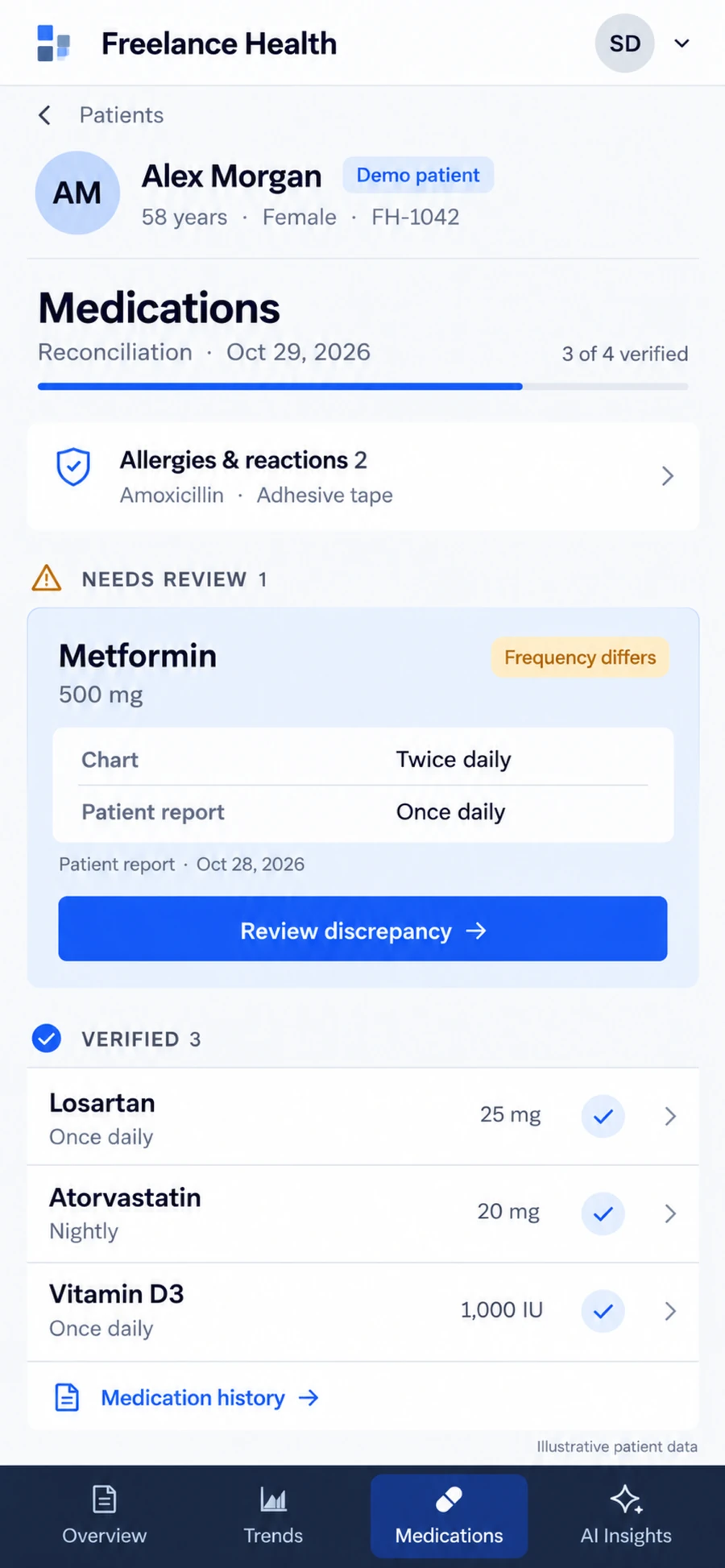
Medication updates, new laboratory results, and progress notes can trigger another assessment. Physicians can also request an immediate refresh from the dashboard.
The workflow keeps the underlying patient records at the center of every analysis, with timestamps and previous assessments available for review.
How assessments stay up to date
Automated Insights That Evolve With the Patient
Clinical information is constantly changing. A physician may enter a new progress note, laboratory results may become available, or a patient’s medication regimen may be updated.
Solaeris designed the AI Insights system to support event-driven updates and on-demand analysis.
When relevant patient information changes, the system can automatically queue a new assessment. Routine updates are typically processed toward the end of the business day, consolidating changes to optimize API utilization and processing costs.
Physicians can also request an immediate refresh directly from the patient dashboard whenever a new assessment is needed.
The platform maintains a history of previous insights, allowing the AI to consider prior assessments and identify how its recommendations have evolved.
Importantly, each new assessment is grounded in the underlying patient records rather than treating previous AI-generated conclusions as established medical facts. This helps reduce the risk of errors propagating through successive analyses.
A clearly displayed timestamp informs physicians when the latest assessment was generated.
04 / Evidence within reach
A recommendation
with a source.
Patient-record provenance and medical literature sit alongside the assessment. Physicians can examine the evidence, apply their expertise, and decide what comes next.
Grounding each recommendation
Evidence-Grounded Clinical Recommendations
Physicians need access to the medical evidence supporting each recommendation so they can evaluate its relevance to the patient.
Our integration emphasizes grounding suggested diagnoses and recommended actions in published medical guidelines and peer-reviewed research.
The AI Insights interface presents citations alongside its clinical findings, enabling physicians to examine supporting literature and independently evaluate the model’s reasoning.
The physician remains responsible for interpreting these recommendations and determining the appropriate course of care.
 Patient records + Published literature
Early results
An AI second opinion
physicians value.
Participating physicians identified AI Insights as the most important feature of their custom EHR.
Early feedback included a potential diagnosis that had previously been overlooked, along with additional diagnostic considerations and follow-up actions.
These preliminary observations have not yet been validated through a formal clinical outcomes study.
Early feedback and the bigger opportunity
Early Results: An AI Second Opinion Physicians Value
Initial feedback from the medical practice has been overwhelmingly positive.
The participating physicians identified AI Insights as the single most important feature of their custom EHR system.
In one case, a physician reported that the AI surfaced a potential diagnosis that a previous physician had overlooked. In other instances, the system helped identify additional diagnostic considerations and follow-up actions that might otherwise have been missed.
Physicians also reported encouraging signs of improved patient care during preliminary testing, although these early observations have not yet been validated through a formal clinical outcomes study.
Physicians began using the AI-generated assessments as a second opinion to inform their own clinical evaluation.
The Bigger Opportunity: From Recordkeeping to Clinical Intelligence
Traditional EHR systems were designed primarily to document, organize, and retrieve patient information.
AI offers an opportunity to transform those systems into proactive clinical decision-support platforms that continuously evaluate patient histories, identify important changes, and help physicians make more informed decisions.
This project required close collaboration with physicians to organize patient information and integrate assessments into everyday care.
Combining clinical expertise, data engineering, automation, and evidence-grounded AI helped the team build a system that fits into the physician’s workflow.
Interested in integrating AI into your healthcare platform or business workflows?